INTRODUCTION
When it comes to material handling, choosing the right conveyor system is just as important as selecting the right machinery for production. A well-designed conveyor not only moves materials from one point to another but also improves productivity, reduces manual effort, and ensures a smooth workflow across the manufacturing process.
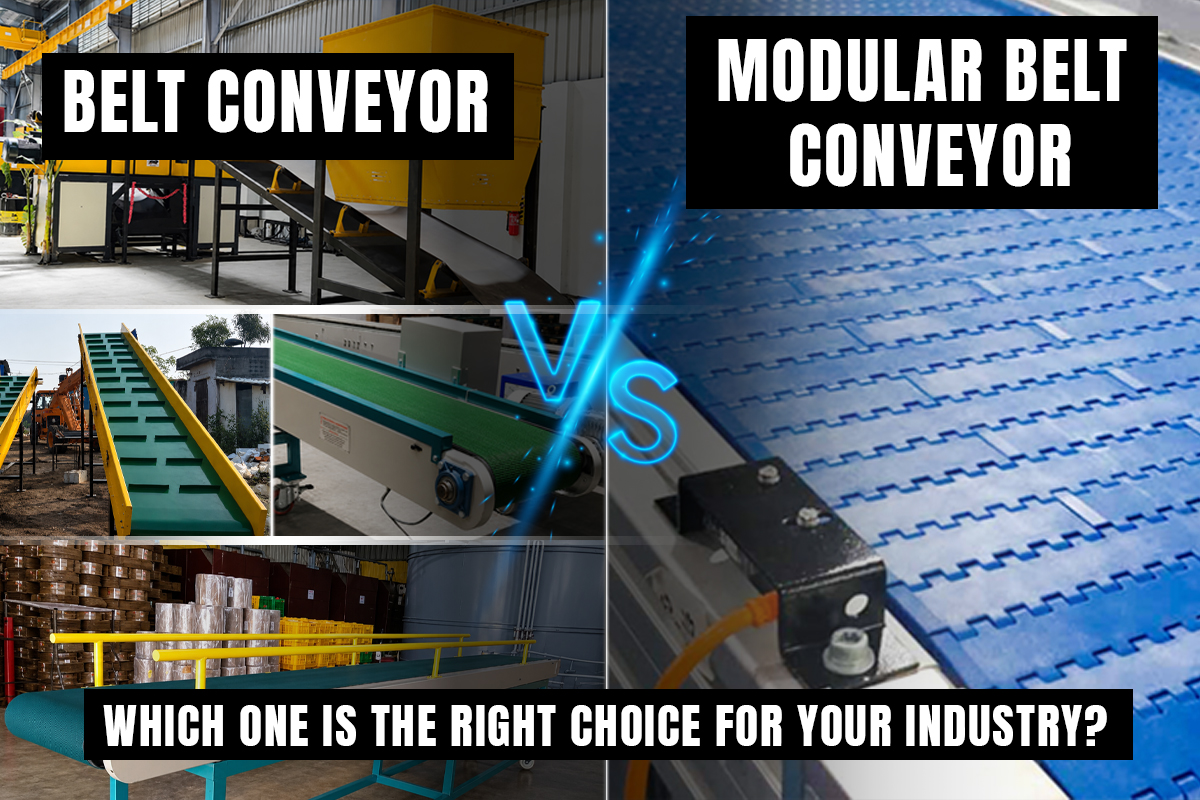
Among the various conveyor systems available today, Belt Conveyors and Modular Belt Conveyors are two of the most widely used solutions. While they may appear similar at first glance, they are designed to meet different operational needs.
Understanding the strengths of each system can help businesses make an informed investment that supports both current production requirements and future growth.
Understanding Belt Conveyors
A Belt Conveyor uses a continuous belt made from rubber, PVC, PU, or other suitable materials that rotates over pulleys to transport products from one location to another.
Because of their simple design and reliable performance, belt conveyors are one of the most commonly used material handling systems across manufacturing industries.
They are ideal for transporting cartons, bags, boxes, lightweight products, packaged goods, and other materials over long distances with minimal manual intervention.
Advantages of Belt Conveyors
Cost-Effective Solution
For many industries, belt conveyors offer an economical solution without compromising performance. Their straightforward design makes installation and maintenance relatively simple.
Smooth Material Movement
The continuous belt surface provides stable transportation, reducing the chances of product damage during movement.
Suitable for Long Distances
Belt conveyors can efficiently transport materials across large production areas, warehouses, and assembly lines.
Quiet Operation
Compared to several other conveying systems, belt conveyors operate with minimal noise, creating a better working environment.
Easy Maintenance
Routine inspections, belt adjustments, and periodic servicing are generally sufficient to keep the system operating efficiently for years.
APPLICATIONS
Common Applications of Belt Conveyors
Belt conveyors are widely used in:
- Packaging industries
- Warehouses
- Logistics centers
- FMCG manufacturing
- Textile industries
- Electronics manufacturing
- Assembly lines
- Distribution centers
- Agriculture
- E-commerce fulfilment facilities
Their versatility makes them one of the most preferred conveyor solutions across different sectors.
Understanding Modular Belt Conveyors
Unlike traditional belt conveyors, Modular Belt Conveyors use interlocking plastic modules that are connected together to form the conveying surface.
Instead of replacing an entire belt when damage occurs, individual modules can be removed and replaced, making maintenance quicker and more economical.
Modular conveyors are especially useful in industries where hygiene, moisture resistance, and durability are essential.
Advantages of Modular Belt Conveyors
High Durability
The modular construction makes these conveyors highly resistant to wear and impact, allowing them to handle demanding industrial environments.
Easy Cleaning
Industries such as food processing and pharmaceuticals require strict hygiene standards.
Since modular belts can be washed and cleaned easily, they are widely preferred in these sectors.
Resistant to Moisture and Chemicals
Unlike conventional belts, modular belts perform well in wet environments and areas exposed to chemicals or cleaning agents.
Flexible Design
Modular conveyors can be designed with curves, inclines, declines, and complex layouts, making them suitable for facilities with limited space.
Faster Maintenance
If one section becomes damaged, only the affected module needs replacement instead of the complete conveyor belt.
This significantly reduces maintenance time and operational downtime.
Common Applications of Modular Belt Conveyors
Modular belt conveyors are commonly used in:
- Food processing plants
- Beverage industries
- Pharmaceutical manufacturing
- Dairy processing
- Meat and poultry industries
- Seafood processing
- Bakery production
- Bottling plants
- Packaging industries
- Chemical processing facilities
Their ability to withstand moisture and frequent cleaning makes them ideal for hygienic production environments.
Belt Conveyor vs. Modular Belt Conveyor
| Feature | Belt Conveyor | Modular Belt Conveyor |
|---|---|---|
| Conveyor Surface | Continuous Rubber/PVC Belt | Interlocking Plastic Modules |
| Initial Investment | Lower | Higher |
| Maintenance | Easy | Very Easy |
| Product Replacement | Entire Belt | Individual Modules |
| Hygiene | Moderate | Excellent |
| Water Resistance | Moderate | Excellent |
| Chemical Resistance | Limited | High |
| Curved Layout | Limited | Highly Flexible |
| Durability | Good | Excellent |
| Long Distance Transport | Excellent | Good |
| Heavy-Duty Applications | Good | Excellent |
Which Conveyor Should You Choose?
The right conveyor depends on your operational requirements rather than simply comparing costs.
Choose a Belt Conveyor if:
- You need an economical material handling solution.
- Products travel long distances.
- Your facility handles cartons, bags, or packaged goods.
- The production environment is relatively dry.
- You require continuous, high-speed transportation.
For many manufacturing and warehouse operations, a belt conveyor delivers reliable performance while keeping investment costs manageable.
Choose a Modular Belt Conveyor if:
- Hygiene is a priority.
- Products are exposed to water or frequent washing.
- Your facility has curved conveyor layouts.
- You require higher durability.
- You need quick maintenance with minimal downtime.
Industries dealing with food, beverages, pharmaceuticals, and chemical processing often prefer modular conveyors because of their flexibility and easy maintenance.
Factors to Consider Before Making a Decision
Before investing in any conveyor system, businesses should evaluate several important factors.
Nature of the Product
Consider the weight, size, shape, and fragility of the materials being transported.
Production Capacity
Your conveyor system should support both current production requirements and future expansion plans.
Operating Environment
Dust, moisture, temperature, chemicals, and hygiene standards all influence the type of conveyor that will perform best.
Maintenance Requirements
Downtime directly impacts production. Selecting a conveyor that is easy to maintain helps improve overall operational efficiency.
Budget
The lowest purchase price is not always the most economical choice. Consider the total cost of ownership, including maintenance, spare parts, energy consumption, and expected service life.
Why the Right Conveyor Matters
A properly selected conveyor system can provide measurable business benefits, including:
- Faster production cycles
- Reduced labour dependency
- Lower maintenance costs
- Improved workplace safety
- Better product handling
- Increased operational efficiency
- Reduced material damage
- Higher return on investment
Rather than viewing a conveyor as a simple transport mechanism, successful manufacturers consider it an integral part of their production strategy.
Why Choose Sree Vinayaga Automation?
At Sree Vinayaga Automation, we specialize in designing and manufacturing customized material handling solutions that meet the specific requirements of modern industries.
Our expertise includes:
- Belt Conveyors
- Modular Belt Conveyors
- Truck Loading Conveyors
- Roller Conveyors
- Screw Conveyors
- Bucket Elevators
- Gravity Conveyors
- Bag Stackers
- Customized Material Handling Systems
Every conveyor system is designed with a focus on durability, performance, safety, and long-term operational efficiency. Our team works closely with clients to understand their workflow and recommend solutions that maximize productivity while minimizing downtime.
CONCLUSION
Both Belt Conveyors and Modular Belt Conveyors are reliable material handling solutions, but each serves different operational needs. A belt conveyor is an excellent choice for cost-effective, long-distance transportation of packaged goods, while a modular belt conveyor is ideal for industries that require superior hygiene, durability, and flexibility.
The best choice depends on your product type, operating environment, production capacity, and long-term business goals. Partnering with an experienced conveyor manufacturer ensures you invest in a solution that supports efficiency, reliability, and future growth.
Whether you're planning a new production line or upgrading an existing facility, selecting the right conveyor system can make a significant difference in productivity and overall operational performance.
1. What is the main difference between a belt conveyor and a modular belt conveyor?
A belt conveyor uses a continuous belt made of rubber, PVC, or PU, while a modular belt conveyor uses interlocking plastic modules. Modular belts are more durable and easier to maintain in demanding environments.
2. Which conveyor is better for food processing industries?
Modular belt conveyors are generally the preferred choice for food processing because they are easy to clean, resistant to moisture, and meet higher hygiene standards.
3. Are modular belt conveyors more expensive?
Yes, the initial investment is usually higher than a traditional belt conveyor. However, lower maintenance costs and longer service life often result in better long-term value.
4. Can conveyor systems be customized?
Yes. Conveyor systems can be designed with different lengths, widths, speeds, load capacities, and layouts to match specific production requirements.
Looking for the right conveyor solution for your industry? Sree Vinayaga Automation offers customized conveyor systems designed to improve productivity, streamline material handling, and support long-term business growth. Get in touch with our team to discuss your requirements and find the ideal solution for your operations.